Blog · · 10 min read
AI agent cost and latency: set budgets before adding complexity
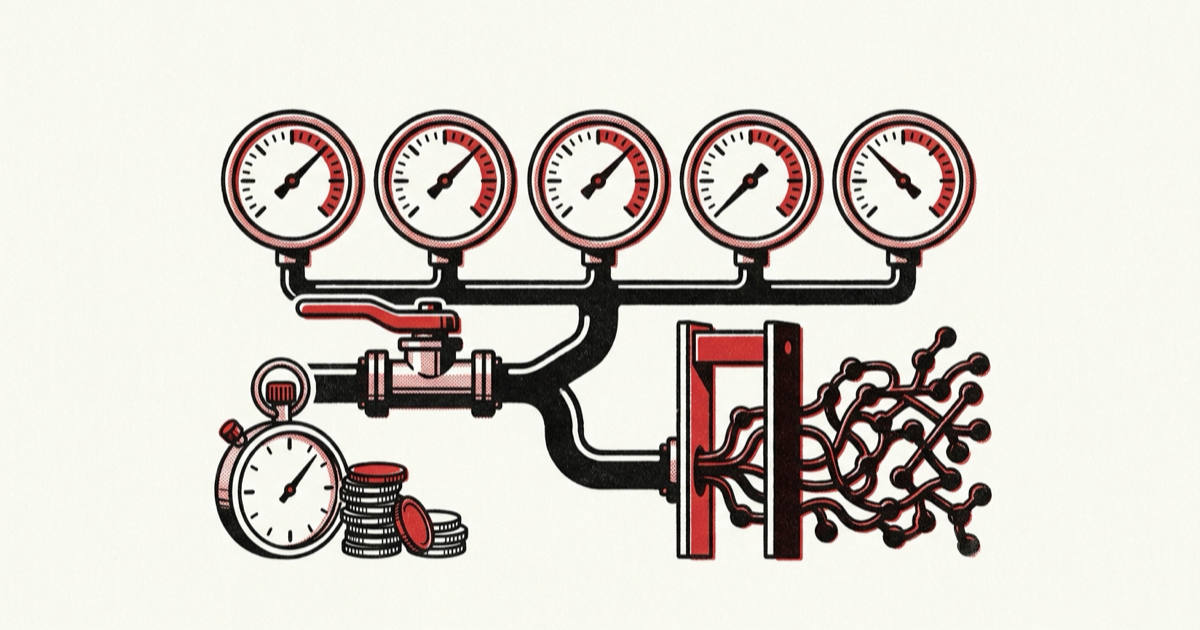
AI agent cost and latency become unpredictable when a product team adds more model calls, tools, retries, and handoffs without defining where a run must stop. The API bill grows, users wait through long tails, and retries consume the remaining budget. A multi-agent design can also make a simple task harder to debug. Anthropic recommends starting with the simplest sufficient design because agentic systems trade latency and cost for task performance. This guide turns that principle into an operating contract: set product limits first, record every unit of work, and require measured evidence before increasing complexity.
Start with a budgeted single-agent baseline
Do not begin with a multi-agent diagram. Begin with the least complex implementation that can complete one well-defined product task.
Use this progression:
- Try one model call with deterministic validation.
- Add retrieval or a single tool only when the baseline cannot access required information.
- Use one tool-calling agent when the task needs dynamic sequencing.
- Add more model passes only when an evaluation shows a specific quality gap.
- Add another agent only when specialization or isolation beats the single-agent baseline under the same test set and budget.
Multi-agent systems still have valid uses. A baseline gives them a control group. Microsoft's architecture guidance places agent designs on a complexity spectrum and recommends the lowest level that reliably meets the requirement. It also identifies coordination overhead, latency, cost, and new failure modes as the price of multi-agent orchestration.
The baseline needs more than an average response time and a monthly model invoice. Record task success, p50, p95, and p99 wall time, model and tool calls per run, tokens, retries, estimated spend, and operator interventions. Without that ledger, the team cannot tell whether added reasoning improves the product or merely moves failure into a slower and more expensive path.
Why agent cost and latency grow faster than expected
A normal request often has one dominant service call, while an agent run chains several kinds of work. It can plan, retrieve, call a tool, inspect the result, retry, summarize, request approval, and continue. Each step adds its own wait time and can create another branch.
The total wall time is approximately the critical path through the run:
total_wall_time = model_time
                + sequential_tool_time
                + retry_time
                + queue_and_approval_time
                + orchestration_overhead
Parallel work changes the critical path but does not make the work free. Independent tool calls can run together, while dependent calls still wait for earlier results. If one branch is slow or retries, it can hold the whole run open. A practical latency plan therefore needs both a first-response target and a final-completion target. Kunal Ganglani's latency guide separates first-token and total-turn behavior and emphasizes multi-hop accumulation and tail latency rather than relying on a single model benchmark.
Cost accumulates in a similar way. The relevant unit is the whole successful outcome, not one model call. The run can include input and output tokens, retrieval, embeddings, remote tools, retries, verification passes, human review, and retained state. TutorialsLogic's cost and latency guide recommends explicit ceilings for model calls, tokens, tools, retries, wall time, and estimated spend, with different limits for interactive and background work.
Reliability also affects both numbers. A failed tool call may trigger another model turn, which selects another tool, which adds latency and cost without improving the outcome. The author of Forge reported this compounding behavior while testing local tool-calling models and attributed material gains to retry nudges and error recovery. Treat the Forge Hacker News discussion as a practitioner report, not a universal benchmark. Its useful lesson is that retries and recovery are architecture decisions that belong in the run budget.
Build the AI agent cost and latency contract
Enforce the budget in the orchestrator. A threshold that only appears on a dashboard can alert the team, but it cannot stop or degrade a run.
1. Define the product objective first
Choose one task, audience, and completion condition. For example: resolve a routine support ticket by retrieving the account state, proposing one approved action, executing it, and recording an action receipt.
Define three classes of requirement:
- Quality: task success, correct tool choice, valid arguments, and acceptable recovery.
- Time: first useful response, final completion, and approval wait excluded or reported separately.
- Spend: maximum estimated run cost and cost per successful outcome over the evaluation set.
Do not optimize cost per request while ignoring failed requests. A cheaper run that requires more retries or more human cleanup can have a higher cost per successful outcome.
2. Add hard run limits
Enforce limits in the orchestrator, outside model control. The model can receive the remaining budget as context, but it must not be able to raise its own ceiling.
At minimum, configure:
- maximum model turns;
- maximum input and output tokens;
- maximum tool calls;
- maximum retries by failure class;
- maximum wall-clock execution time;
- maximum estimated model spend;
- maximum concurrent branches;
- deadline for approval or external callback.
The host application should check the budget before each expensive step and again after the result. The second check matters because a call can consume more time or tokens than predicted. Microsoft's guidance also recommends iteration limits for a single tool-using agent to prevent infinite tool-call loops.
3. End every exhausted budget in a useful state
A hard limit should not turn into a generic error after the agent has already done useful work. Define the exhaustion outcome for each task class:
- Return a verified partial result when incomplete work still helps.
- Ask one focused clarification when ambiguity caused the extra turns.
- Queue background completion when the task no longer belongs in an interactive request.
- Request approval before exceeding a higher spend tier.
- Hand off to a person with the action history and unresolved step.
- Fail closed when a partial side effect would be unsafe.
The result should include a typed reason such as time_budget_exhausted, tool_budget_exhausted, or spend_budget_exhausted. That makes the product state visible and gives evaluation code something deterministic to grade.
4. Record a per-run budget ledger
Store one ledger beside the product action. Model-provider logs alone are insufficient. A provider trace may know token use but not whether the ticket was resolved, the payment was reversed, or the user abandoned the flow.
The ledger should contain:
- task and run identifiers;
- user and tenant scope;
- workflow version, model, and prompt version;
- per-step start, end, outcome, tokens, and estimated cost;
- tool duration and retry reason;
- remaining limits before each step;
- final product outcome;
- whether a person intervened;
- whether the run ended by success, cancellation, error, or budget exhaustion.
Use the ledger to calculate cost per successful outcome, not to expose sensitive prompts to every dashboard. Keep product identifiers and redacted traces linked through access-controlled correlation IDs.
5. Promote complexity through a controlled test
Compare the proposed design with the baseline on the same versioned task set. Change one architectural variable at a time. If the proposal adds a verifier pass, do not also change the model, retrieval corpus, and tool schema in the same test.
A promotion gate can require all of the following:
- a defined improvement in task success or a required safety invariant;
- p95 and p99 wall time within the product target;
- cost per successful outcome within its ceiling;
- no increase in hidden failures or human cleanup;
- a useful result when any budget is exhausted;
- traces that identify which step caused the regression.
Keep the exact thresholds product-specific. An interactive editor, a background report, and a high-value fraud investigation should not share one latency or spend limit.
Example: budget a support-ticket resolution agent
The following values are illustrative, not industry benchmarks. They show how to make the contract explicit for one interactive workflow.
workflow: resolve_routine_support_ticket
budget:
  first_useful_response_ms: 2500
  final_completion_ms: 12000
  max_model_turns: 4
  max_tool_calls: 5
  max_retries:
    transient: 1
    permanent: 0
  max_input_tokens: 18000
  max_output_tokens: 2500
  max_estimated_cost_usd: 0.20
on_exhaustion:
  time: handoff_with_action_history
  tool_calls: ask_one_clarifying_question
  tokens: summarize_verified_progress
  spend: require_approval_for_next_tier
promotion_gate:
  compare_against: single_agent_v1
  require_task_success_improvement: true
  require_p95_within_budget: true
  require_cost_per_success_within_budget: true
Start with one agent that has narrow account, ticket, and action tools. Run a versioned replay set that includes successful resolutions, missing data, tool timeouts, permission denials, and ambiguous requests. If failures cluster around overloaded tool selection, improve tool descriptions or split the tool surface before adding another agent.
Only test a specialist agent when the evidence points to a specialization problem. Redis describes single-agent and multi-agent systems as a tradeoff involving performance, cost, and coordination. A second agent should have a specific job, a bounded input and output contract, and its own slice of the parent budget. It must not receive a fresh unlimited budget simply because orchestration crossed an agent boundary.
Handle failure and recovery
Budget enforcement changes failure behavior. A timeout can leave a tool in flight, while an exhausted token budget can interrupt cleanup. Define the recovery rules before launch.
Distinguish retryable failures from permanent ones. Retry a short network interruption only when the tool operation is safe to repeat. Do not spend the last available turn retrying a permission denial, invalid input, or policy rejection. Those need a different product outcome.
Reserve capacity for cleanup. If a workflow can perform side effects, do not allow planning and execution to consume every millisecond and token while leaving nothing for status recording or compensation. Treat the recovery reserve as unavailable to ordinary reasoning.
Propagate child limits. In a multi-agent run, each child receives a deadline and spend allocation from the parent. The parent rejects new work when the remaining budget cannot cover the minimum safe execution and recovery path.
Make cancellation real. A user cancellation should stop queued model turns and tool calls where possible, mark in-flight outcomes as known or unknown, and prevent a late callback from silently resuming an expired run.
Keep a deterministic fallback. Codebridge's comparison of single and multi-agent architecture argues that added coordination must earn its complexity against a measured baseline. If the more complex path exceeds its budget or loses required observability, route the task back to the last validated design rather than improvising another agent handoff.
Verify the budget in production
Exercise enforcement in tests. A useful verification suite includes these cases:
- A normal run succeeds below every limit and records the final product outcome.
- A model loop reaches the turn ceiling and returns the declared typed result.
- A slow tool crosses the wall-time deadline and cannot trigger a late duplicate action.
- A transient failure uses only its allowed retry and updates the ledger.
- A permanent failure consumes no retry budget.
- Token and spend ceilings stop the next expensive call before it starts.
- Budget exhaustion returns the configured partial result, approval request, or handoff.
- A child agent cannot exceed the parent deadline or spend allocation.
- Cancellation prevents queued work and records unknown in-flight outcomes.
- The dashboard can calculate task success, tail latency, and cost per successful outcome from the same run records.
Run the suite against every workflow, model, prompt, and orchestration version. Then canary the proposed version with a bounded traffic slice. Compare outcome quality and budget behavior alongside aggregate tokens and average response time.
Watch the full distribution because averages can hide a small set of very slow or expensive runs. Track p95 and p99 latency, spend percentiles, retries per outcome, budget-exhaustion rate, and human handoff rate. Break them down by workflow version and outcome so one failing path cannot hide inside healthy traffic.
Common mistakes
Token and request accounting both hide important costs. A token-only budget misses tool duration, retries, queue time, verification, and human review. Cost per request makes cheap failures look efficient, so track the whole run and calculate cost per successful outcome alongside quality and safety checks.
Budget controls can also disappear at process boundaries. A fresh ceiling for every child agent defeats the parent budget. A timeout does not cancel in-flight work either: the caller may stop waiting while tools continue executing. Allocate child limits from the remaining run envelope, and propagate deadlines and cancellation into the orchestration and tool layers.
Architecture choices create the last two common errors. Another agent will not repair ambiguous schemas, broad permissions, or poor error contracts, so fix the tool layer first. Median-only optimization also hides slow-tail behavior. Keep p95 and p99 within the declared product target.
What to do next
Choose one agent workflow today and add a per-run ledger with hard limits for turns, tools, retries, wall time, tokens, and estimated spend. Replay its existing evaluation set, record cost per successful outcome and tail latency, and refuse the next complexity increase until it passes a written promotion gate for AI agent cost and latency.
References
- Anthropic: Building effective agents supports starting with the simplest sufficient system and treating latency and cost as explicit tradeoffs for task performance.
- Microsoft: AI agent orchestration patterns supports the complexity spectrum, single-agent default, iteration limits, and the overhead introduced by multi-agent orchestration.
- Forge reliability discussion on Hacker News provides a practitioner report about compounding multi-step failures, retries, and error recovery.
- Kunal Ganglani: AI agent latency budgets supports separating first-response and total-turn latency and measuring multi-hop and tail behavior.
- TutorialsLogic: AI agent cost and latency supports explicit run budgets for model calls, tools, tokens, retries, wall time, and estimated spend.
- Redis: Single-agent versus multi-agent systems supports the architecture tradeoff among coordination, performance, cost, and complexity.
- Codebridge: Single-agent versus multi-agent architecture supports requiring measured gains before accepting multi-agent coordination and debugging overhead.