Blog · · 8 min read
AI agent drift monitoring: catch behavior drift before users report it
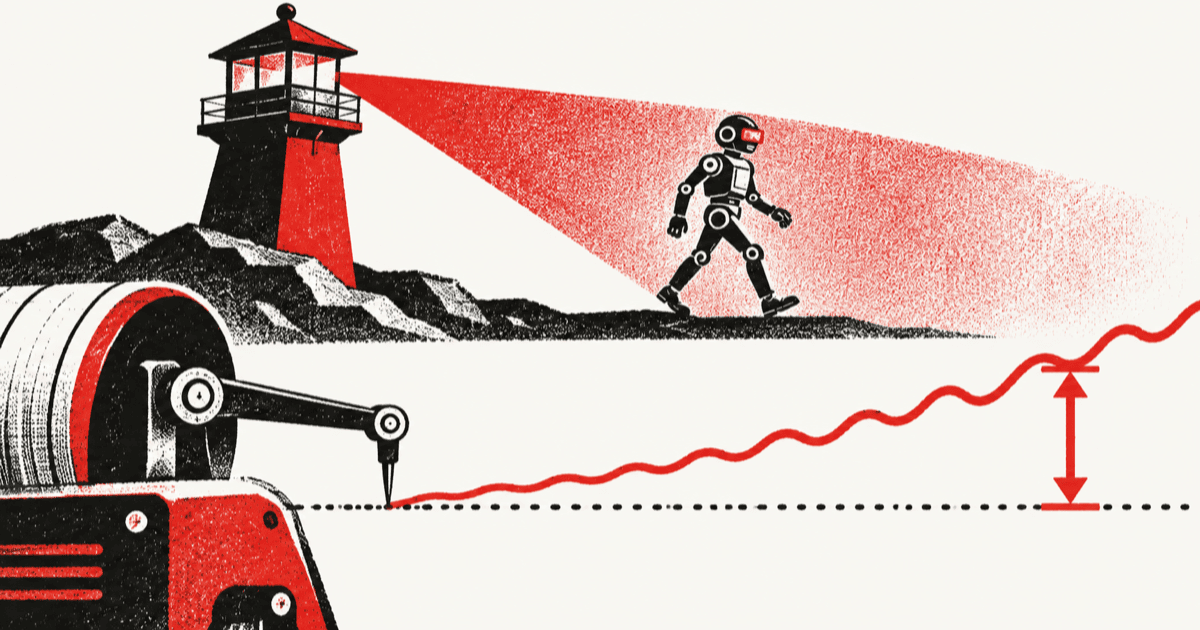
AI agent drift monitoring has to catch behavior changes that ordinary uptime dashboards miss. Your API can stay available while the agent quietly chooses a different tool, retrieves older documents, refuses more valid requests, spends twice as much, or completes fewer tasks. The trigger may be a model update, prompt edit, index rebuild, tool change, policy change, or new traffic mix. No application deployment is required.
The fix is a controlled comparison loop: version a known-good baseline, compare equivalent segments, run fixed canaries, correlate every shift with dependency changes, and require an explicit rollback or acceptance decision. This gives operators evidence before support tickets become the monitoring system.
Why green dashboards miss agent behavior drift
Traditional service monitoring answers whether requests arrive, how long they take, and whether the server returns an error. An agent can return HTTP 200 on time and still produce a worse outcome. It may call a search tool less often, pass subtly different arguments, recover from failures through a costly loop, or cite the wrong document generation.
AWS guidance on detecting drift in generative AI applications distinguishes input, output, and behavioral shifts and recommends combining statistical monitoring, fixed probes, human review, and remediation. Microsoft's agent lifecycle guidance names several moving surfaces: knowledge, source documents, user patterns, and integrations. Monitoring only your own deployments leaves those surfaces invisible.
Treat drift as a persistent change in a behavior distribution, not one strange run. A single timeout or unusual answer belongs in incident triage. A new normal that survives a useful sample and appears within a comparable task segment belongs in drift investigation.
Segmented comparisons expose failures that aggregate metrics hide. Suppose a support agent serves four products. Retrieval accuracy for one product falls sharply after a documentation migration, but that product contributes only a small fraction of traffic. The blended average barely moves. A product-level comparison catches the change. The Uncoil drift guide demonstrates the same difference between segment signals and aggregate stability.
Define the AI agent drift monitoring contract before thresholds
Do not start with a list of convenient metrics. Start with the product behavior the agent must preserve. For each supported workflow, define:
- the eligible request and user segment;
- the acceptable final product outcome;
- the required and forbidden tool paths;
- the authoritative data sources and freshness rules;
- the cost, latency, retry, and refusal boundaries;
- the evidence that proves completion;
- the owner who can accept a changed baseline.
This contract separates a harmless wording change from an operational regression. Output length may move while verified task success stays stable. That is a weak signal. Tool success can stay flat while the agent begins selecting the wrong tool for one intent. That is a real product failure even though no dependency returned an error.
AWS Agentic AI Lens monitoring guidance calls for more than model latency and token counts. It includes reasoning quality, tool selection and execution, memory, routing, handoffs, business outcomes, and trace correlation. Use those layers to build the contract, but keep the product outcome authoritative.
Classify each field as one of three signal types:
- Outcome signals: accepted task success, verified side effects, user correction, reversal, escalation, or abandonment.
- Behavior signals: tool sequence, argument shape, retrieved source IDs, refusal category, recovery path, handoff route, and output schema validity.
- Operating signals: latency, token use, model cost, retry count, rate-limit response, queue age, and provider errors.
Behavior signals identify where to investigate, outcome signals show whether the change affected the product, and operating signals expose its cost or an infrastructure contribution.
Create a versioned baseline manifest
A rolling dashboard window is not a trustworthy baseline by itself. If a regression lasts long enough, the rolling window absorbs it. The bad behavior then becomes normal by calculation.
Store a reviewed baseline manifest beside the agent release record. It should identify the period, cohort, dependency versions, signal definitions, and approval that made the baseline valid.
{
  "baseline_id": "support-agent-product-c-v17",
  "agent_release": "17.3.2",
  "window": {
    "start": "2026-08-03T00:00:00Z",
    "end": "2026-08-16T23:59:59Z"
  },
  "segment": {
    "workflow": "answer-product-question",
    "product": "product-c",
    "locale": "en-US",
    "tenant_tier": "standard"
  },
  "dependencies": {
    "model_snapshot": "provider-model-snapshot",
    "prompt_version": "prompt-42",
    "retrieval_index": "docs-v4-2026-08-02",
    "tool_contracts": "tools-19",
    "policy_bundle": "policy-11"
  },
  "signals": [
    "verified_answer_rate",
    "retrieved_source_distribution",
    "tool_selection_distribution",
    "refusal_category",
    "cost_per_verified_answer"
  ],
  "approved_by": "agent-service-owner"
}
These dependency fields supply the change-correlation keys for diagnosis. A model alias without a resolved snapshot is weaker evidence than a snapshot or provider revision. A retrieval index name without the source-content revision leaves a migration invisible. Record both whenever the platform exposes them.
Choose a baseline window long enough to include normal weekly and workload variation. Exclude incidents, partial rollouts, one-off campaigns, and known data migrations. Store distributions or histograms, not only averages. A stable mean can hide a new tail, a second mode, or a regression isolated to one segment.
Compare equivalent production segments
Every scheduled comparison should hold the meaningful dimensions steady. Compare the current Product C support traffic with the Product C support baseline, not with all support traffic. Keep workflow, locale, tenant tier, channel, autonomy level, and relevant tool path consistent where sample size permits.
Start with exact segments defined in the behavior contract. Merge segments only when the low-volume analysis rule says the cohorts are behaviorally equivalent. Never merge solely to make a graph look statistically smoother.
For each segment, calculate changes in outcome, behavior, and operating signals. Avoid treating every metric movement as an alert. Route a candidate drift event when one of these conditions holds:
- a product outcome crosses its reviewed boundary;
- two independent proxy signals move in a consistent direction;
- a fixed canary changes behavior;
- a high-risk forbidden path appears at all;
- the change persists across the minimum comparison sample or duration.
The Collibra production monitoring guide separates model quality, agent behavior, data drift, operational health, and task success. A flat operating metric should not cancel a degrading outcome metric.
Low traffic needs an explicit policy. Use wider comparison windows, exact fixed canaries, and periodic human review rather than pretending a tiny live sample can support a precise statistical claim. State that evidence is insufficient when it is. An uncertain result should create a review task, not a fabricated confidence score.
Add fixed canaries and sampled continuous evaluation
Production comparisons detect changes in real traffic, but changing user mix can look like changing agent behavior. Fixed canaries provide a stable second surface. Run a small, versioned set of representative tasks on a schedule and after any known model, prompt, retrieval, tool, policy, or configuration change.
Each canary should assert observable outcomes and path constraints. Check the selected tool, required argument fields, forbidden calls, retrieved source family, output schema, refusal category, side-effect receipt, and final verified result. Do not require identical prose from a nondeterministic model unless exact text is part of the contract.
Microsoft documents continuous evaluation over sampled agent traces, with evaluator results stored alongside production telemetry. Combine that sampled live evaluation with the fixed canary suite. Live samples catch traffic and dependency interactions the canaries did not anticipate. Canaries distinguish agent change from population change.
An author report, Claude Code issue 91391, describes a model-specific failure to follow defined skills across repeated tests. This report does not establish an incidence rate. It shows why dependency-independent canaries must test instruction adherence and tool behavior, not only endpoint availability.
Correlate drift with every mutable dependency
Detection without attribution produces noisy tickets. Build a change ledger that records effective time and scope for every mutable input to agent behavior:
- resolved model snapshot, alias target, router, and fallback;
- system prompt, templates, examples, and context-trimming logic;
- retrieval corpus, index, embedding model, filters, and freshness policy;
- tool schema, implementation, upstream API, permissions, and default values;
- safety policy, guardrail version, authorization rules, and feature flags;
- runtime, framework, SDK, and orchestration configuration;
- traffic source, product launch, locale expansion, and tenant mix.
When a signal shifts, find the earliest changed comparison window, then join it with the ledger by time, segment, and affected dependency. Correlation is a lead, not proof. Confirm it by replaying canaries against the suspected old and new dependency where possible, or by a controlled rollback when the risk and platform allow it.
The production-scale paper Evaluating Agentic AI in the Wild describes longitudinal degradation patterns that static deployment-time benchmarks miss, including interface drift, tool over-selection, orchestration collapse, and confidence inflation. A change ledger turns those patterns from vague degradation into testable hypotheses.
Route each confirmed shift through one decision state machine
Do not let an alert close because the chart returned to normal or the rolling window moved on. Persist the investigation and its disposition.
if outcome_boundary_breached or forbidden_path_observed:
    freeze_autonomy_for_affected_segment()
    open_drift_case(baseline_id, comparison_window, changed_signals)

suspects = correlate_with_change_ledger(drift_case)
results = replay_fixed_canaries(suspects)

if safe_rollback_restores_contract(results):
    rollback_change()
    verify_live_segment_against_original_baseline()
elif repair_restores_contract(results):
    deploy_repair_through_normal_release_gate()
    verify_live_segment_against_original_baseline()
elif owner_accepts_intentional_change(results):
    record_tradeoffs_and_approval()
    create_new_verified_baseline()
else:
    keep_segment_in_degraded_or_review_required_mode()
Make re-baselining an explicit owner decision rather than an automated maintenance task. Require evidence that the changed behavior is intended, safe, and useful. Keep the old manifest so later incidents can reconstruct when and why the product contract changed.
Test the drift-control loop itself
A drift system can fail silently like the agent it watches. Verify the control loop with injected changes:
- Route canary traffic to a model snapshot that changes tool formatting.
- Remove one document collection from a test retrieval index.
- Change a tool default while preserving its HTTP success response.
- Alter the traffic mix without changing any agent dependency.
- Disable one evaluator or delay its results.
- Attempt to approve a new baseline without the required owner.
- Confirm that a resolved case cannot delete its original evidence.
Each test should prove detection, segment scope, attribution evidence, operating response, and final verification. A traffic-mix test must identify population drift without blaming the model. An evaluator outage must produce an unknown quality state rather than silently treating missing scores as passing.
Watch the monitoring cost too. Sample expensive evaluators according to risk, but retain cheap structural signals for every trace where privacy policy permits. Full prompt and response retention is not automatically justified. Store the minimum data needed for comparison, protect sensitive content, and keep references to source and tool versions so the investigation remains reproducible.
Start with one workflow and one explicit baseline
Choose a production workflow with a verified outcome, such as ticket resolution, account lookup, or document-grounded support. Define its segments, outcome boundary, tool-path rules, and dependency ledger. Approve one known-good baseline. Add ten to twenty fixed canaries that test the workflow's critical paths and failure behavior. Run the comparison job, inject one controlled retrieval or tool change, and prove the system opens, diagnoses, resolves, and verifies the drift case.
Do not begin by buying a dashboard or monitoring every metric. Begin your AI agent drift monitoring program by proving that one meaningful behavior change cannot pass unnoticed or become the new normal without an accountable decision.