Blog · · 10 min read
Build an AI generated content copyright and provenance release gate
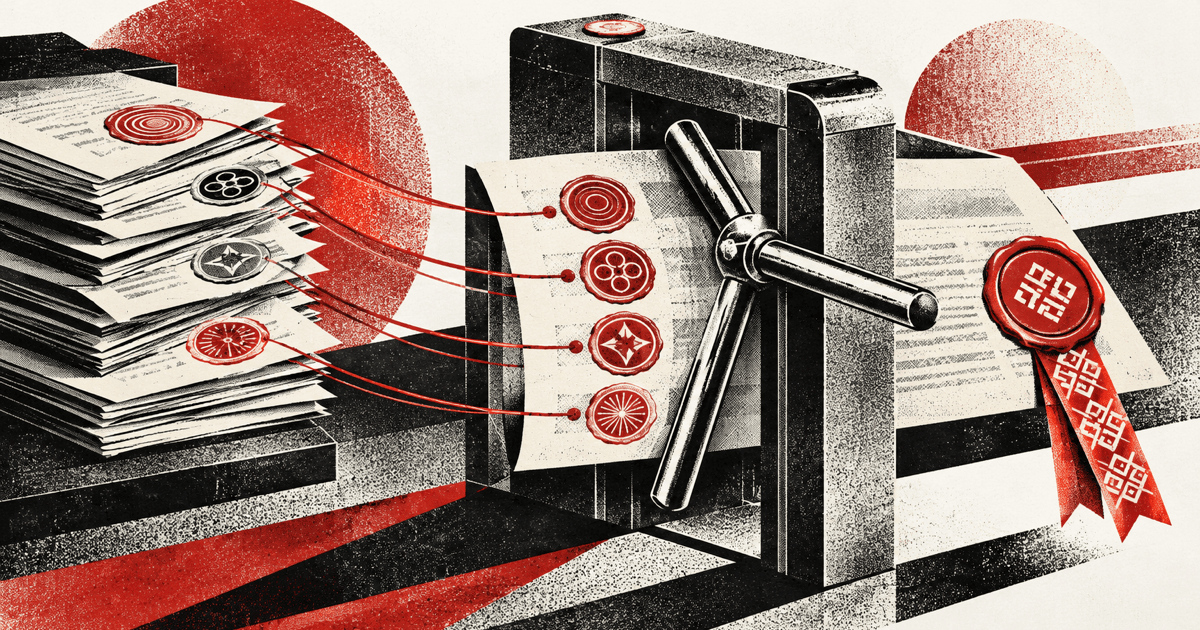
AI generated content copyright questions become operational failures when an agent publishes text, code, images, or files and the product keeps only the final bytes. The team can no longer show which sources and tools contributed, what rights applied, who made substantive edits, which similarity warnings appeared, or who approved that exact version. A complaint then becomes a manual investigation across logs that were never designed to answer it. The fix is a release gate that preserves source lineage, evaluates product policy, records human contribution, binds approval to the output hash, and supports later correction or withdrawal.
Treat publication as a release transaction
A successful generation call establishes only that the agent produced a candidate. Publication requires a separate product decision.
Use this sequence:
- Freeze the candidate bytes and calculate an output hash.
- Assemble a provenance bundle for retrieved sources, user inputs, model calls, tool outputs, and human edits.
- Resolve the rights and consent policy that applies to each ingredient.
- Run modality-specific similarity and attribution checks.
- Record the human contribution and any required reviewer decision.
- Issue a release receipt bound to the candidate hash and policy version.
- Attach portable provenance where supported, then index the publication for correction or takedown.
An autonomous product needs provenance, tool rights, similarity, human contribution, escalation, and recordkeeping expressed as persisted state and enforceable transitions. A checklist completed after publication is too late.
Counsel or an accountable policy owner should define the rules for licenses, consent, territory, use case, and escalation. Engineering should make those rules executable, versioned, and auditable.
Why output rights disappear across an agent run
The final artifact does not contain its production history
An output may combine user-uploaded material, retrieved documents, public web pages, licensed assets, model generations, deterministic tool output, and human edits. Saving the final file does not preserve those relationships.
The W3C PROV Data Model provides a useful neutral vocabulary. It distinguishes entities, activities, agents, derivations, and responsibility. You do not need to implement every PROV-DM relation, but the separation prevents one overloaded source_url field from pretending to describe a multi-step production chain.
A SelfDrivingWiki issue reports this exact implementation gap. Generated pages had no attribution field, while processed sources did not expose the extraction technique or processing date. The proposal calls for one shared provenance vocabulary across pages, sources, exports, REST, and MCP delivery paths. The report describes one implementation rather than a universal platform behavior.
Tool-caused output can bypass editor attribution
Agents often create files indirectly by running compilers, renderers, export jobs, or shell commands. An attribution system that watches only direct model edits will miss those outputs.
The author of git-ai issue 1127 reproduced this failure with AI-invoked code generators. Files created by the shell command were classified as human-authored because the tracking path covered editor hooks but not tool-caused writes. Your provenance collector must follow causal actions as well as file-write APIs.
Provenance does not prove permission
Signed provenance can show that a claim was attached to an asset and has not been changed. It does not decide whether a source license permits the planned use, whether attribution is required, whether consent has expired, or whether a customer contract requires disclosure.
C2PA guidance for AI and machine learning describes signed Content Credentials, asset references, ingredients, hashes, and sidecar manifests. Use these primitives to show origin and detect tampering. Rights policy still decides whether the product may publish the output.
A prompt is not an authorship record
The U.S. Copyright Office report on AI copyrightability says that using AI as an assistive tool does not remove protection from a work as a whole. Protection depends on the nature and extent of human contribution. The report also concludes that prompts alone do not adequately control the expressive elements produced by the generally available systems it examined.
A prompt or approval click does not justify human_authored: true. Preserve the actual human selections, arrangements, additions, deletions, and edits. Keep the assessment scoped to the relevant jurisdiction and policy version.
Build the AI generated content copyright gate
Create one immutable candidate envelope
Freeze the candidate before review. Any post-review edit creates a new candidate hash and requires a new decision.
{
  "candidate_id": "out_01K4...",
  "artifact_hash": "sha256:6c1f...",
  "artifact_type": "text/markdown",
  "tenant_id": "tenant_42",
  "run_id": "run_01K4...",
  "release_policy_version": 12,
  "ingredients": [
    {
      "entity_id": "src_204",
      "kind": "retrieved_document",
      "snapshot_hash": "sha256:31b9...",
      "source_uri": "https://example.com/licensed-guide",
      "rights_record_id": "rights_882",
      "activity_id": "retrieval_77"
    },
    {
      "entity_id": "tool_991",
      "kind": "tool_output",
      "snapshot_hash": "sha256:903a...",
      "tool_release": "report-renderer@3.4.1",
      "activity_id": "tool_call_18"
    }
  ],
  "human_contributions": ["editset_17", "selection_22"],
  "similarity_scan_id": "scan_55",
  "review_state": "pending"
}
Store the envelope server-side. Only trusted product services may supply license classifications, reviewer identity, policy results, and the final release state.
Capture sources at the point of use
Record an ingredient when content enters the run, not after the model has blended it into an answer. Keep:
- a stable source identifier and retrieval timestamp;
- a content hash or immutable snapshot reference;
- the tenant, user, and purpose that authorized retrieval;
- the extractor, tool, model, or transformation that produced the next entity;
- available license, consent, attribution, territory, and expiry data;
- the policy version that admitted the ingredient;
- a link to the parent activity and resulting entity.
If storing a full snapshot would violate retention or licensing rules, store the minimum permitted evidence, such as a hash, source version, passage locator, rights record, and secure evidence reference. Make that limitation visible in the release decision.
Resolve obligations through policy, not model judgment
Normalize rights data into product decisions such as:
| Decision | Meaning | Release behavior |
|---|---|---|
allow | Planned use satisfies the current rule | Continue and retain the rule version |
allow_with_attribution | Use is allowed if specified credit is attached | Generate and verify attribution before release |
allow_with_disclosure | Contract or policy requires AI-use disclosure | Add the approved disclosure to the destination |
review | Evidence is incomplete or the use is high impact | Route to an eligible reviewer |
deny | The planned use conflicts with policy | Block publication and preserve the denial receipt |
unknown | Rights data or policy evaluation failed | Fail closed for publication, not for evidence retention |
Evaluate every ingredient and the combined output. Keep the output blocked until each ingredient passes policy or receives a recorded reviewer disposition.
Run similarity checks with explicit limits
Similarity checks can identify public-code matches, repeated text, near-duplicate images, or known protected assets. They cannot prove that an unmatched output is clear.
GitHub's Copilot code-referencing documentation shows a concrete design. For detected public-code matches, it can record source URLs and a detected license so the user can choose attribution or removal. The same documentation states that private and non-GitHub code are outside the index, and the index refreshes periodically.
A clean result should not shorten review, because the scanner only knows its own corpus and an unmatched output has therefore not been checked against anything outside it. Persist the scanner version, corpus scope, thresholds, findings, and limitations. Policy should decide whether a match means attribution, removal, regeneration, or review. Set thresholds separately for code, prose, images, audio, and video.
Record human contribution and reviewer authority
Store edit operations or version diffs that show what a person contributed. A useful record can include selected alternatives, rearranged sections, rewritten passages, added original material, removed model output, and the before-and-after hashes.
Keep approval separate. The reviewer should see the source bundle, rights outcomes, similarity findings, human-contribution record, destination, intended use, and unresolved limitations. Bind the decision to reviewer identity, current role, timestamp, policy version, and artifact hash. If any of those inputs change, the old approval no longer releases the new candidate.
Issue a release receipt and portable credential
A release receipt should contain the final decision, candidate hash, destination, policy version, ingredient-set hash, required attribution or disclosure, reviewer record, scanner result, and expiry or recheck condition. The publisher accepts only a valid receipt for the exact bytes it will send.
For supported modalities, attach a Content Credential or equivalent provenance record. Microsoft's Foundry content-provenance documentation describes cryptographically signed C2PA metadata, invisible watermarks, detection tools, and an API. It also says support varies by modality, model family, deployment type, and output modality. Check actual capability rather than assuming every generated asset can carry the same signal.
If an export format strips embedded metadata, keep a sidecar credential and a product-level lookup keyed by the artifact hash. Make metadata loss observable instead of treating publication success as proof that provenance survived.
Handle failures, corrections, and takedowns
Block publication when a required source snapshot, rights record, scan, disclosure, or approval is missing. Preserve the candidate and its partial evidence so the team can repair the problem without rerunning the agent and producing unrelated bytes.
A source can later change its license, revoke consent, or challenge the use. A scanner can add corpus coverage and find a match it missed earlier. A reviewer can withdraw a decision. Build a reverse lineage index from each source, rights record, scanner finding, and policy version to every released artifact.
Use this recovery sequence:
- Open a case linked to the affected source or release receipt.
- Freeze new publication and derivative generation for the affected lineage.
- Locate every destination and downstream version by hash.
- Re-evaluate under the current policy without overwriting the historical decision.
- Correct attribution, replace the asset, restrict access, or withdraw it as required.
- Record the disposition and verify each destination.
Retain the evidence that explains why the earlier release occurred. Apply retention and access controls so the evidence record does not become an unrestricted copy of the disputed source.
Verify the gate with adversarial tests
Test the release gate as a security and integrity boundary. At minimum:
- retrieve one source with required attribution and prove the published output contains the approved credit;
- pass licensed material through a tool and prove its rights record survives the indirect transformation;
- invoke a code generator through a shell tool and prove the output inherits agent and tool attribution;
- omit one ingredient snapshot and confirm that publication stops with
unknown; - alter one byte after approval and confirm that the publisher rejects the old receipt;
- remove embedded C2PA metadata during export and confirm that the missing signal is detected;
- make the similarity service unavailable and confirm the policy chooses review or denial, not an implicit pass;
- expire reviewer authority between approval request and decision;
- revoke a source right and locate every affected publication through reverse lineage;
- retry the publisher and confirm one receipt cannot create conflicting destination records;
- verify that users without evidence access cannot read protected source snapshots through provenance links.
Also test false confidence. A clean similarity result must include scanner scope and limitations. A valid signature must not bypass rights policy. A human click must not be counted as substantive authorship. A stored URL without a content version must not satisfy an immutable-source requirement.
Common implementation mistakes
A model vendor's general terms cannot establish publication rights without the product's account, plan, input source, destination, and contract.
Keep provenance outside the final file as well. Common transformations can remove metadata, and text support may differ from image, audio, or video support.
Capture ingredients and causal activities while the run executes. An agent's retrospective source summary cannot reconstruct missing lineage.
Similarity scanning is one evidence source with incomplete coverage. The rights policy and reviewer still decide whether to release the output.
Freeze the candidate bytes before review and bind the decision to their hash. An edit creates a new candidate.
Index released artifacts by source, policy, scanner finding, destination, and hash so a takedown never depends on searching filenames and chat logs.
Implement one publication path first
Choose one agent workflow that generates a customer-visible file. Add an immutable candidate envelope, two ingredient types, a versioned rights policy, one similarity scanner, a human-contribution record, and a release receipt. Put a deliberate attribution requirement in one test source, invoke an indirect file-producing tool, and prove that publication fails until the requirement appears in the exact approved output.
Then change one byte, remove the provenance metadata, and revoke the source record. The gate should reject the altered file, surface the missing credential, and locate the released version for correction. Extend the design to more modalities and destinations only after that complete AI generated content copyright path works from source capture through takedown.