Blog · · 9 min read
AI agent confidence calibration: when to act, verify, abstain, or escalate
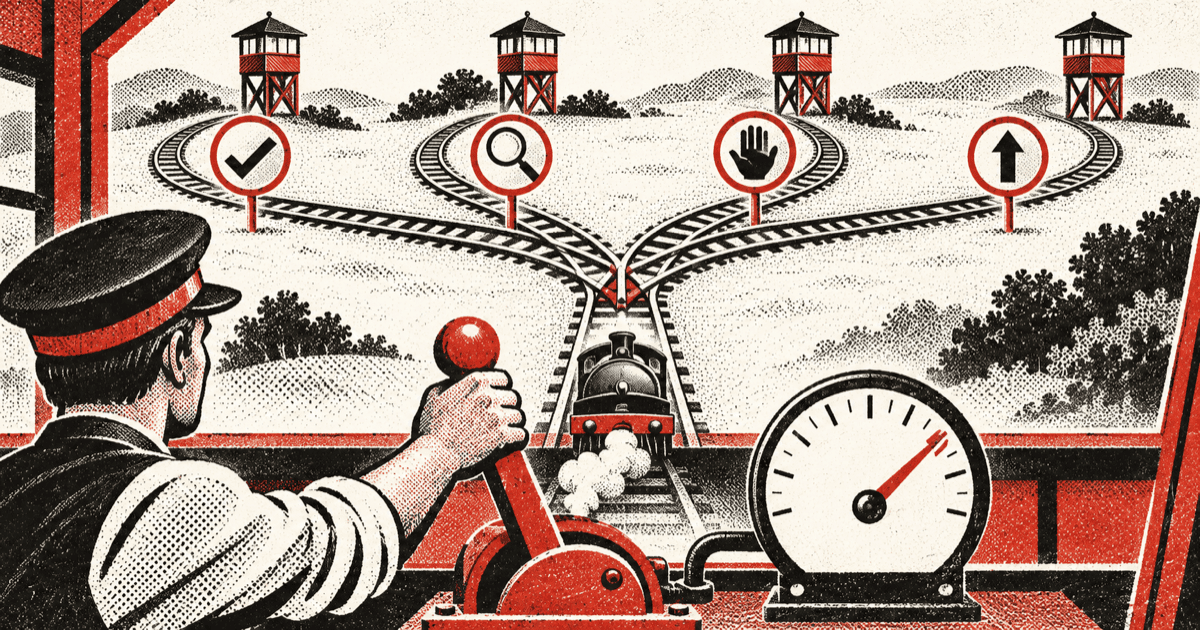
AI agent confidence calibration fails when a fluent answer or self-reported percentage becomes permission to change product state. The agent can sound certain after selecting the wrong tool, reading stale data, missing a required field, or receiving conflicting results. One global cutoff makes the problem worse: it lets risky actions through or sends routine, reversible work to a human.
Build a decision control that learns from verified outcomes, inspects the whole trajectory, applies deterministic eligibility rules, and prices the loss of each possible mistake. Its output routes the run to act, verify, clarify, abstain, or escalate, with an evidence record that can be tested again after every release.
Why model confidence is not execution authority
A model's verbal confidence is one signal about generated text. It is not a guarantee that the requested product action is valid, authorized, current, or complete. OpenAI's analysis of hallucination incentives explains that ordinary accuracy scoring can reward guessing and should distinguish errors from abstentions. An action-taking system has an additional problem: the cost of a wrong guess depends on what the tool will do.
Confidence can degrade across a trajectory even if the final response reads well. The agent may misread the request, choose an adjacent tool, lose a constraint during planning, receive partial data, or ignore a tool error. The 2026 Agentic Confidence Calibration paper treats model, tool, and environment uncertainty as sources that compound across a multi-step run. Product agents need that run-level view because the decision concerns the trajectory that happened, including its tool and environment evidence.
Start by separating three questions:
- Is this action eligible? Required fields, current authorization, policy, data freshness, and preconditions must pass deterministic checks.
- How likely is the proposed outcome to be correct? Estimate this from evidence and trajectory features, then calibrate the estimate against verified outcomes.
- What should the product do at this risk level? Choose a route from the cost of a false action, false abstention, unnecessary review, or delayed clarification.
A confidence score must never override failed eligibility. A high estimate cannot supply a missing account identifier, revive expired authority, or prove that inventory is still available.
Define the routing contract first
Do not begin by asking the model for a number between zero and one. Define the decisions the product needs to make and the evidence each decision must preserve.
| Route | Use when | Required product behavior |
|---|---|---|
| Act | Eligible, low-loss action with calibrated evidence above its action threshold | Execute with an idempotency key, then verify the effect |
| Verify | Evidence is incomplete but an authoritative read can resolve it | Fetch or reconcile the missing fact before deciding |
| Clarify | The user can resolve a missing or ambiguous input | Ask one bounded question and persist the pending action |
| Abstain | The action cannot be completed safely with available evidence or capability | Return a typed non-action with concrete reasons |
| Escalate | A qualified human must decide because loss or policy requires it | Bind the review to the exact proposed action and evidence version |
Low confidence has several causes. Missing input calls for clarification. Conflicting tool results call for verification. An unavailable capability calls for abstention. A valid but consequential action may require escalation even when the estimate is high.
Published guidance reaches similar operational conclusions. Stackwell's confidence-score design separates deterministic ineligibility from confidence, attaches reason codes, and varies policy by action class. Treat that design as an implementation reference, not proof that its thresholds will work for your traffic.
Label outcomes the product can verify
Calibration requires a dataset that joins the decision-time record to an authoritative outcome. Do not label success from the model's final message. Use product receipts, reconciled state, accepted user outcomes, and qualified review.
A compact record can look like this:
{
  "decision_id": "dec_7841",
  "agent_release": "support-agent-2026-09-10.3",
  "workflow": "refund_request",
  "action_class": "financial_reversible",
  "candidate_action": "issue_refund",
  "eligibility": {
    "authorized": true,
    "required_fields_present": true,
    "policy_allowed": true,
    "data_version_current": true
  },
  "trajectory_features": {
    "plan_revisions": 1,
    "tool_errors": 0,
    "conflicting_results": 0,
    "source_age_seconds": 18,
    "required_evidence_coverage": 1.0
  },
  "raw_score": 0.81,
  "calibrator_version": "refund-v4",
  "calibrated_success_probability": 0.68,
  "selected_route": "escalate",
  "reason_codes": ["amount_above_auto_limit"],
  "outcome": "human_rejected_ineligible_item",
  "outcome_verified_at": "2026-09-10T14:05:00Z"
}
The fields are an implementation recommendation. Keep the feature set small enough to audit. Useful starting signals include required-evidence coverage, tool error types, result conflicts, source versions, stale-data checks, plan revisions, schema validation, postcondition availability, and whether the requested action appears in the supported workflow catalog.
Avoid user content, prompts, or private tool payloads in low-cardinality metrics. Store the detailed decision record under the same access and retention rules as the run. Export bounded reason codes and aggregate calibration measures to monitoring.
Run AI agent confidence calibration on your own release
The raw score can come from several sources: a purpose-built classifier, an ensemble, task-specific deterministic signals, a model critique, or a combination. The FP8 abstention guide discusses verbalized confidence, token-derived signals, consistency, external verification, and learned confidence models. None should be adopted as a universal execution gate without local outcome data.
Split the data by time or release so the validation set represents runs the calibrator did not fit. Preserve important slices such as workflow, action class, tenant tier, language, model, tool version, and error path. Aggregate calibration can look acceptable while one consequential slice is badly overconfident.
Measure at least:
- reliability by score bucket, comparing predicted success with verified success
- expected calibration error as a summary, with the bucket plot retained beside it
- false-action and false-abstention rates by action class
- risk at a fixed automation coverage
- human-review load and the share of escalations that changed the decision
- unresolved outcomes that cannot be used as clean labels
The score should mean one declared event. For example: "the proposed action will pass deterministic preconditions, execute once, and produce the verified requested product outcome." Do not mix answer correctness, user satisfaction, policy compliance, and tool availability into an undefined number.
Route by expected loss, not one global threshold
A calibrated probability becomes useful only after the product attaches consequences to decisions. For each action class, estimate the relative loss of a wrong action, a missed safe action, a review, a clarification, and delay. Use consistent relative ordering agreed by product, operations, security, and domain owners instead of false financial precision.
A simplified policy can evaluate the available routes:
function route(decision, policy):
    if not decision.eligibility.required_fields_present:
        return CLARIFY

    if not decision.eligibility.authorized:
        return ABSTAIN

    if not decision.eligibility.policy_allowed:
        return ESCALATE if policy.review_can_override else ABSTAIN

    if decision.has_conflicting_results or decision.data_is_stale:
        return VERIFY

    p = calibrate(decision.raw_score, decision.release, decision.action_class)

    losses = {
        ACT: (1 - p) * policy.wrong_action_loss,
        ABSTAIN: p * policy.missed_action_loss,
        ESCALATE: policy.review_cost + policy.review_delay_loss,
        VERIFY: policy.verification_cost + policy.verification_delay_loss
    }

    return lowest_allowed_loss(losses, policy.allowed_routes)
The implementation must enforce allowed routes outside the model. A model can propose ACT; it cannot grant itself eligibility or lower the action's loss class. The chosen route, policy version, calibrator version, evidence versions, and reason codes belong in a calibration receipt attached to the run.
Test both sides of the boundary
A dataset full of answerable tasks rewards systems that always act. AgentAbstain addresses this with paired tasks that differ by whether acting is appropriate, across missing parameters, ambiguity, conflicting constraints, high-stakes actions, missing tools, tool failures, conflicting evidence, and emergent risk. Use the same paired principle for your product.
For a refund workflow, build pairs such as:
- complete order, eligible item, and current policy versus a missing order identifier
- refundable item versus an item outside the allowed window
- one authoritative amount versus conflicting amounts from two systems
- reversible credit below the autonomous limit versus a cash refund above it
- verified tool receipt versus a timeout with an unknown effect
- active user authority versus authority revoked after the plan was created
Each pair should differ in one decision-relevant condition. Assert the expected route, not just the final prose. The missing identifier should clarify. The policy failure should abstain. The conflicting amount should verify. The high-loss refund should escalate. The timeout after a possible write should reconcile rather than retry.
A practitioner introducing an uncertainty-aware runtime described a concrete observability problem: serialized tool outputs can prevent the policy from seeing execution quality directly. Treat that as an author report, not a platform guarantee. It still provides a useful test question: does the selector receive the typed error, validation result, freshness, and receipt signals it needs, or only flattened text?
Roll out the selector as a versioned product control
Deploying a calibrator changes autonomy. Version it with the other release components and test its routing behavior before it changes product state.
- Instrument without routing. Persist features, raw scores, eligibility results, proposed routes, and verified outcomes while the existing policy stays authoritative.
- Build the labeled baseline. Remove unresolved outcomes, inspect label leakage, and review slices with enough consequence to need separate policy.
- Calibrate in shadow mode. Compare proposed routes with the current decision and record disagreements without changing user-visible behavior.
- Enable verification and clarification first. These routes gather evidence or user input without granting broader action authority.
- Enable bounded actions by class. Start with reversible, low-loss actions and hard volume or value limits.
- Keep sampled review. Inspect some high-confidence actions and some abstentions so blind spots do not disappear from the dataset.
- Expire on material change. A model, prompt, tool schema, source system, policy, feature definition, or traffic shift can invalidate calibration.
When calibration expires, fall back to the previous verified policy or a safer route. Do not keep autonomous thresholds active merely because the service is reachable.
Handle failures without hiding uncertainty
The selector needs typed failure behavior of its own.
- If the calibrator is unavailable, use deterministic eligibility and the configured fail-safe route for that action class.
- If required features are missing, record which feature failed and choose verify, clarify, abstain, or escalate. Do not replace missing evidence with a neutral score.
- If no recent calibration receipt matches the agent release, block autonomous action for classes that require one.
- If outcome reconciliation is pending, exclude the record from clean calibration labels and keep the run unresolved.
- If reviewer decisions vary, route the disagreement into label governance rather than training on whichever answer arrived first.
- If automation coverage rises while verified success falls, stop promotion and inspect the changed slices.
Expose the policy decision and its reasons. Users and operators usually need concrete language such as "current inventory could not be verified" or "refund exceeds the autonomous limit." A bare 68% badge does not tell them what happens next.
Verify the control before increasing autonomy
Require a release report for every selector version. It should name the agent release, dataset window, outcome definition, feature schema, calibrator, action policies, slice results, unresolved-label rate, paired fixtures, and approvers.
Block promotion when any of these checks fail:
- an ineligible run can reach an action tool
- a should-abstain pair routes to act
- a should-act pair is rejected without the expected cost tradeoff
- the calibration plot shows material overconfidence in a consequential slice
- the decision cannot be reproduced from stored versions and reason codes
- a changed model, prompt, tool, policy, or source bypasses recalibration
- the selector lacks the typed tool and verification signals used during validation
Choose one product workflow, define its verified success event and five route losses, then create ten paired fixtures before collecting any AI agent confidence calibration percentage. Run those fixtures against the current release and keep the routing policy in shadow mode until both the should-act and should-abstain cases pass.