Blog · · 10 min read
Event-driven AI agents: trigger product work without runaway automation
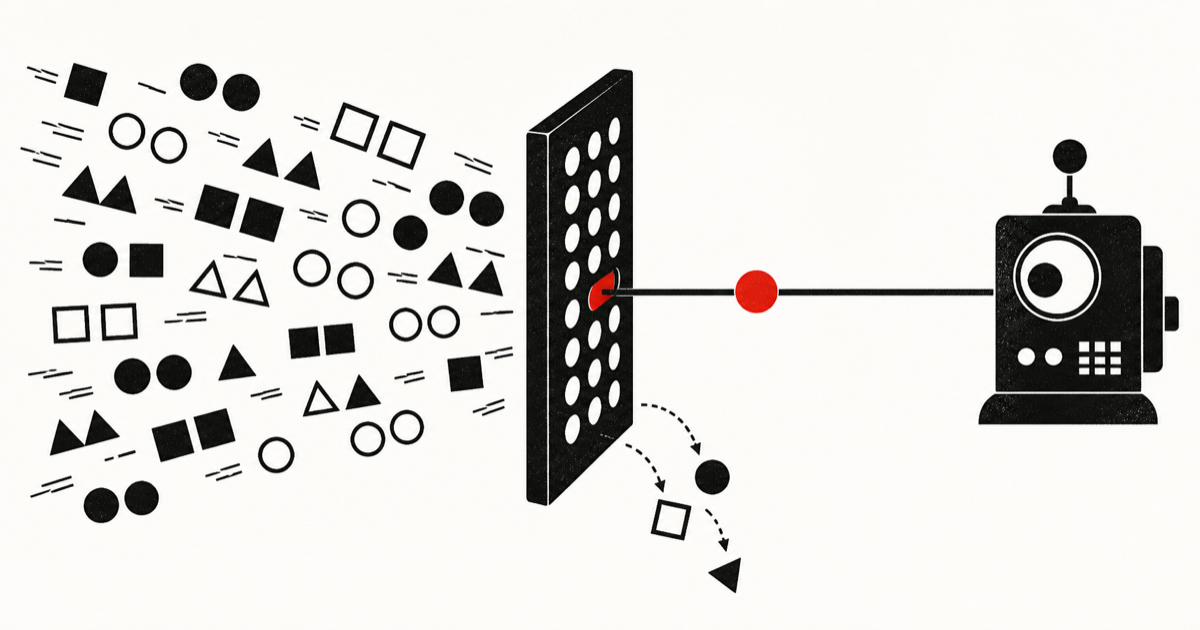
Event-driven AI agents can react to an overdue ticket, a changed order, or a newly uploaded document without waiting for someone to open chat. Connecting the event source straight to the model loop is unsafe. A retried webhook may start two runs, a burst may exhaust the budget, and a delayed event may rely on authority that has expired. Route accepted events through a trigger gateway first. The gateway checks the source and eligibility, suppresses duplicate work, resolves current authority, creates a bounded durable run, and keeps the causal link from event to effect.
Why event-driven AI agents need a trigger boundary
Most callback handlers assume that delivery means work should start. Redelivery breaks that assumption. Webhook senders and brokers send an event again when an acknowledgement is lost or a consumer fails. The CloudEvents specification defines source plus id as the identity of a distinct event and permits a resent duplicate to keep the same ID. A receiver that ignores those fields turns ordinary delivery recovery into duplicate agent work.
Unique events can still be noisy. A customer import may emit hundreds of record changes for one business transition. Starting a model run for each update creates fan-out that the product did not ask for, so the runtime needs limits on concurrency, queue depth, and spend before any model call.
An authenticated event may still lack current authority. The payload might name the user who changed a record, but that user can lose access before a delayed run starts. A schedule may have no user at all. The trigger has to resolve a named automation owner or a current delegated principal instead of treating payload fields as authentication.
Event-driven systems bring asynchronous error handling and eventual consistency. The Azure Architecture Center's event-driven architecture guidance calls out idempotent message processing, coordination, and dedicated error handling as operating concerns. Adding an LLM does not remove them. It adds another nondeterministic step after delivery.
Put a trigger gateway before the agent runtime
The gateway belongs in the product control plane, not in the agent's tool set. It records why autonomous work may start and hands the model only an accepted, bounded task.
1. Verify and normalize the event
Authenticate the transport before reading business fields. Verify a webhook signature and timestamp, require mTLS or workload identity for internal publishers, and map a schedule to a named configuration revision. Reject unsupported event types and schema versions.
Normalize accepted input into one envelope. CloudEvents is a portable base because it separates event metadata from domain data:
{
  "specversion": "1.0",
  "id": "evt_48192",
  "source": "https://product.example/tickets",
  "type": "com.example.ticket.sla_breached.v2",
  "subject": "ticket/t_1842",
  "time": "2026-07-30T09:15:00Z",
  "datacontenttype": "application/json",
  "data": {
    "ticket_id": "t_1842",
    "observed_version": 37,
    "breach_policy": "priority-support-v4"
  }
}
The envelope identifies the occurrence. It should not carry browser sessions, raw API keys, or permission claims chosen by the publisher. Store the original delivery hash and verified publisher identity beside the normalized record for investigation.
2. Apply deterministic eligibility rules
Decide whether the event can start work before asking a model what to do. Eligibility should be a versioned rule over trusted fields and current product configuration:
- Is this event type enabled for this tenant and environment?
- Is the subject in the configured workflow scope?
- Is the observed record version still relevant?
- Is an automation owner assigned and active?
- Has the trigger reached its concurrency, queue, or spend ceiling?
- Does the event require approval before any run begins?
A model can later choose among allowed tools. It should not decide whether an unsigned webhook is trustworthy or whether a tenant purchased the feature.
3. Deduplicate, debounce, and coalesce
Use (source, id) as the delivery-deduplication key. Insert the accepted event and its key atomically. If the same key already exists, return the previous receipt rather than creating another run.
Delivery deduplication is not enough. Several distinct events can represent one current need. A ticket edited five times in a minute may require one triage run against the latest version. Define a coalescing key such as (tenant_id, trigger_id, subject) and a short window. Keep every input event in the audit history, but launch one run with the newest relevant state.
Do not coalesce events whose order changes meaning. A payment authorization followed by a cancellation is not equivalent to the final record alone. For those workflows, preserve sequence and let deterministic product logic establish the valid transition before an agent is involved.
4. Resolve current authority
Map the verified source and trigger configuration to an authority mode:
- A user-delegated trigger must confirm that the user still has access and that the delegation covers the requested workflow.
- A tenant automation must use a named service principal with narrow application permissions.
- A system safety trigger should have a separately reviewed owner and action set.
Never fabricate a user for a schedule. Never trust user_id or tenant_id in a webhook payload without binding it to the authenticated publisher and current product records. Pass an authority reference into the run, then reauthorize each tool call through the product's ordinary policy layer.
5. Create a bounded durable run
An accepted trigger should create a run record before dispatch. Record the trigger revision, normalized event ID, causation ID, subject, authority reference, agent release, tool policy, deadline, and budgets for turns, time, tools, and spend.
Acknowledge the delivery after this record is durable, not after the whole agent completes. The run should move through explicit states such as queued, running, needs_input, completed, failed, and cancelled. This keeps transport retries separate from agent retries.
Oracle AI Agent Studio's trigger documentation shows how broad the initiation surface can become: webhook, email, schedule, and business-signal triggers, with delivery attempts, retry delays, and backoff settings. A product-owned gateway gives those trigger types one acceptance and audit contract even when different platforms deliver them.
6. Re-read state before any side effect
The event payload is evidence of a past occurrence. It is not the source of truth for a current write. Before an agent sends a message, updates a record, or calls an external system, load the subject again and compare its version and status with the run's assumptions.
Return a typed stale outcome when the work is no longer needed. For example, an SLA-breach event should not send an escalation if a human already resolved the ticket. Mark the run superseded with the record version that invalidated it. That is a successful safety decision, not an agent failure.
Work through an SLA-breach example
Suppose the support product publishes ticket.sla_breached when a priority ticket exceeds its response target. The desired agent should summarize the case, identify the right escalation queue, and prepare an internal handoff.
The trigger gateway can implement the boundary with ordinary application logic:
receive delivery
  -> verify publisher signature and timestamp
  -> normalize event and validate schema version
  -> insert receipt keyed by source + event_id
  -> load tenant trigger configuration
  -> check eligibility, authority, queue, and budget
  -> coalesce by tenant + trigger + ticket_id
  -> create durable run with causation_id and agent_release
  -> acknowledge accepted receipt
  -> worker reloads ticket and authorization state
  -> agent prepares bounded handoff through allowed tools
  -> product validates current ticket version before writing
  -> record outcome against event, run, action, and subject
If two deliveries carry evt_48192, the second receives the existing receipt. If five distinct ticket updates arrive inside the coalescing window, the gateway records all five and starts one run against the current ticket. If the ticket is resolved before execution, the worker records superseded. If the automation owner lost access, it records authority_revoked and makes no tool call.
The event broker, agent runtime, and product service retry for different reasons. Each layer needs its own idempotency boundary; one shared key cannot represent all of them safely.
Handle backpressure, failure, and replay
A trigger that cannot accept more work should reject or defer before model invocation. Enforce limits by tenant, trigger, event type, and agent release. Return a retryable receipt only when another delivery attempt is safe. For bursty sources, keep events in a durable queue and expose lag, oldest-event age, acceptance rate, coalescing rate, and budget rejection counts.
Use typed intake outcomes:
accepted: a durable run or coalescing group exists;duplicate: the event maps to an existing receipt;ineligible: configuration or current state excludes the work;unauthorized_source: transport identity or signature failed;authority_unavailable: no active principal can own the run;rate_limited: the trigger exceeded a declared ceiling;invalid_event: schema, type, or version failed validation;dead_lettered: bounded delivery or processing attempts were exhausted.
Replay from stored event records through the same gateway, not straight into the runtime. Pin the trigger revision and agent release for incident reproduction, or declare that the replay intentionally uses a new version. Keep side effects disabled by default during diagnostic replay.
Confluent's agentic event-driven architecture covers replay, access controls, policy enforcement, duplicate-command risk, and tracing decisions back to triggering events. Its platform choices are not mandatory. Replay and audit still need the causal event, configuration, state, and agent version, not just a final model response.
Choose the smallest trigger mechanism that fits
Use a signed webhook when an external producer can push one bounded event and the product can acknowledge quickly. Use a schedule for time-based eligibility checks, but make the scheduled job query current product state instead of treating last night's snapshot as fact. Use an event stream when many producers and consumers need durable ordering, buffering, replay, or independent scaling.
Do not introduce a broker only to avoid one reliable API call. Azure's architecture guidance warns that asynchronous debugging, error recovery, and eventual consistency add operational cost. A synchronous request is simpler when the caller needs an immediate result and the work fits the request lifetime.
Likewise, do not call an LLM merely because an event arrived. Deterministic workflows should handle known transitions, thresholds, routing tables, and mandatory notifications. Start an agent when the accepted event opens a task that needs context assembly, judgment within policy, or flexible tool choice.
Verify the trigger boundary
Test the gateway without relying on model quality. A deterministic suite should prove that:
- A bad signature and expired webhook timestamp are rejected before payload use.
- Two deliveries with the same
sourceandidcreate one receipt and one run. - Distinct noisy updates coalesce only when order is irrelevant.
- Cross-tenant subject IDs fail even when the payload is well formed.
- Revoked users and disabled automation owners cannot start or resume work.
- Queue and spend ceilings block dispatch before a model call.
- A stale subject version produces
supersededwithout a side effect. - Dead-letter replay uses the declared trigger and agent versions.
- Diagnostic replay cannot mutate production data.
- Every action links back to its event, trigger revision, authority, run, and agent release.
The Dify maintainers' event-driven workflow foundation issue records demand for schedules, SaaS events, and webhooks, along with the practical pain of polling services and custom glue. It separates trigger-specific input formats from the ordinary workflow start form. A new trigger should fit that stable task contract rather than weaken it.
Avoid five common shortcuts
- Do not invoke the agent in the webhook controller. Persist acceptance, acknowledge, and dispatch separately.
- Do not treat transport authentication as action authorization. Resolve current authority and enforce it again at the tool boundary.
- Do not equate delivery deduplication with effect idempotency. Protect event intake, run creation, and each external action independently.
- Do not replay directly into live tools. Reproduce decisions with side effects disabled, then run a separately authorized recovery action.
- Do not let the model decide its own budget or trigger eligibility. Those are deterministic product controls.
Start with one business event
Choose one event that currently causes polling, manual review, or custom glue code. Define its authenticated source, schema, identity, eligibility rule, authority mode, coalescing behavior, limits, durable run contract, stale-state check, and dead-letter procedure. Run the negative tests before connecting a write tool.
Ship the first trigger only when its receipt can answer five questions: what happened, why autonomous work started, whose authority constrained it, which version ran, and whether the planned effect was still valid against the current record.
References
- CloudEvents specification supports the normalized event envelope and the
sourceplusidduplicate-detection rule. - Microsoft Azure Architecture Center: event-driven architecture style supports the producer, consumer, and channel model plus idempotency, coordination, error-handling, and eventual-consistency tradeoffs.
- Oracle AI Agent Studio: configure workflow triggers supports webhook, email, schedule, and business-signal trigger types and bounded delivery retries.
- Confluent: agentic event-driven systems architecture supports the need for causal audit, replay, access controls, policy enforcement, and duplicate-command protection in event-triggered agent systems.
- Dify issue #23981: event-driven workflow foundation is maintainer-authored problem evidence for schedules, SaaS events, webhooks, polling, and fragmented trigger glue.